The ongoing parsing of Reader's Digests article "50 Secrets Your Vet Won't Tell You" continues....
"New staff or training students sometimes practice injections or catheter placement on your pet. If you'd rather not allow your pet to be used this way, make sure you say something beforehand."
I am having trouble even starting to address this one.
Here's the fact- each state has a set of laws that lays out rules for who can do what. This is as true in veterinary medicine as it is on the human side. So I'm not sure to what this person is referring. Yes, there may be newly graduated vet techs in the practice. Just like the vet might be "new."
But you have to remember that these are highly trained professionals, not random people off the street. They have already completed training, and by law are allowed to perform tasks within their job descriptions. Is there some on the job training? Sure. there's a first (and second) time for everything. Even for me.
Seems to me that if you trust your vet to have hired competent staff, and to oversee them properly, this should not be a concern.
Enjoy your pets!
Showing posts with label dogs. Show all posts
Showing posts with label dogs. Show all posts
Monday, July 16, 2012

Tuesday, July 3, 2012
Secret #12- show me your liscense and registration, please
"At a veterinary meeting I attended, it came out that more than half the vets there had not licensed their dogs, which is required by local law."
Well, this may be a case of "do as I say, not as I do." Or perhaps "shoemakers wives go barefoot and doctor's wives die young."
My dogs are licensed. It is the right thing to do, and the legal one. I encourage my puppy owners to get their licenses. Vets should do the same. I hate to think that the lack of licesnsure is deliberate- we are all busy, and it's easy to overlook some things.
So, vets, let's be sure we "practice what we preach" and take all the right steps to keep our pets safe.
Enjoy your pets!
Well, this may be a case of "do as I say, not as I do." Or perhaps "shoemakers wives go barefoot and doctor's wives die young."
My dogs are licensed. It is the right thing to do, and the legal one. I encourage my puppy owners to get their licenses. Vets should do the same. I hate to think that the lack of licesnsure is deliberate- we are all busy, and it's easy to overlook some things.
So, vets, let's be sure we "practice what we preach" and take all the right steps to keep our pets safe.
Enjoy your pets!
Monday, April 9, 2012
Shooting the grown-ups
I hope those of you who are checking this out now feel you have a better understanding of the importance of the series of puppy vaccines vets recommend. It's a fairly straight forward recommendation, and as for as I know pretty much every veterinarian makes the same recommendations.
Things get a little bit murkier once the pets are grown up- say, over a year old. This is where having one group making protocols that we all follow might help, but the independant nature of vets doesn't really allow that. For now.
Last time we talked about immunity, and the fact that when we give the last set of puppy shots, we expect the body to make and store a blueprint of the fighting factors it can use against specific diseases. These blueprints are stored for a time, but not forever. So we generally recommend vaccinating again about a year after the dog or cat had the last in the series of vaccines. This puts them in the office at about 1 1/2 years of age. They get their good, complete exam (which, frankly, is the most improtant part of the whole visit), and a repeat of the shots they had as a youngster.
Which vaccines, you ask? OK, this is part of the variation.
Which vaccines are used can depend on several factors. Let's talk dogs first. There are three vaccines that are considered "core." These are the shots that are recommended for all dogs, regardless of lifestyle or where in the states they live. Those are rabies, parvovirus and distemper virus.
Then there are non-core vaccines. These can be given based mainly on lifestyle or location. Lyme disease, leptospirosis, bordetella, canine flu are included in this catagory.
 vetmed.auburn.edu
Most vets will give core vaccines to every patient, then add non-core based on that individual patients needs. Lyme for those in lyme endemic areas or hikers, leptospirosis for those expected to be exposed to wildlife or standing water sources, bordetella for those who will be staying at a kennel or going to the groomer. Canine flu is usually resaerved for dogs kenneled or shown. So this is why your veterinarian or vet tech/nurse will ask about lifestyle. We need the information to develop a plan to keep your dog safe.
Cats have two core vaccines- rabies and feline distemper, also called FVRCP, CVR, and a few other things. Plus non-core vaccines like feline leukemia, FIV, and FIP. The decision to add the non-core generally is based on whether your cat is indoor or indoor/outdoor. Be honest with your vet. We just want what is best for your cat. And yes, even cats that are indoors all the time need that exam and the core vaccines. Rabies is required in much of the country for all cats and dogs.
Sounds simple, right?
After that 1 1/2 year old appointment, things get tricky. The core vaccines have been reliably shown to provide immunity that lasts at least 3 years. But not all vets give the shots every 3 years. Some still give them yearly. Some give all three core shots once every 3 years. Some divide them up, so your dog gets one shot each year, on a rotation. Confused yet? I don't blame you.
Let's throw more into the mix. The non-core vaccines tend to have immunity that does not last 3 years. In fact, there's evidence that the bordetella vaccine may only last 6-8 months. So what to do? It depends. No, really. Some places require bordetella every 6 months, some yearly. The other non-core shots are generally boostered every 12 months.
So, the bottom line here is each veterinarian develops a protocol based on current information that he or she is comfortable recommending. Talk to your vet. Ask about the protocol they employ.
Here's my opinion at this time. The exam is the most important part of the whole vet visit. Yes, I can do a complete exam in just a few minutes. Usually while I'm taking to you, asking quiestions. That few minutes of exam is a distillation of 8 years of college and 12 years experience. I could make it take longer, but it wouldn't be any more complete. Just sayin'.
I come from a practice that has been using a 3 year rotating protocol for dogs. We do all core vaccines as puppies, and at the 1 1/2 year appointment. Then we divide them out- distemper, parvo, rabies- one each year on a rotating basis. This means fewer shots at each of those yearly visits. Non-core are all yearly, as needed based on lifestyle.
Cats get baby series, then both core vaccines at 1 1/2. Then FVRCP every 3 years, but rabies yearly. This has to do with the type of rabies vaccine we use for the cats. Ask us. Ask any of us vets at anytime. We are happy to discuss our vaccine protocols and the reasons behind them.
Enjoy your pets!

Things get a little bit murkier once the pets are grown up- say, over a year old. This is where having one group making protocols that we all follow might help, but the independant nature of vets doesn't really allow that. For now.
Last time we talked about immunity, and the fact that when we give the last set of puppy shots, we expect the body to make and store a blueprint of the fighting factors it can use against specific diseases. These blueprints are stored for a time, but not forever. So we generally recommend vaccinating again about a year after the dog or cat had the last in the series of vaccines. This puts them in the office at about 1 1/2 years of age. They get their good, complete exam (which, frankly, is the most improtant part of the whole visit), and a repeat of the shots they had as a youngster.
Which vaccines, you ask? OK, this is part of the variation.
Which vaccines are used can depend on several factors. Let's talk dogs first. There are three vaccines that are considered "core." These are the shots that are recommended for all dogs, regardless of lifestyle or where in the states they live. Those are rabies, parvovirus and distemper virus.
Then there are non-core vaccines. These can be given based mainly on lifestyle or location. Lyme disease, leptospirosis, bordetella, canine flu are included in this catagory.
vetmed.auburn.eduMost vets will give core vaccines to every patient, then add non-core based on that individual patients needs. Lyme for those in lyme endemic areas or hikers, leptospirosis for those expected to be exposed to wildlife or standing water sources, bordetella for those who will be staying at a kennel or going to the groomer. Canine flu is usually resaerved for dogs kenneled or shown. So this is why your veterinarian or vet tech/nurse will ask about lifestyle. We need the information to develop a plan to keep your dog safe.
Cats have two core vaccines- rabies and feline distemper, also called FVRCP, CVR, and a few other things. Plus non-core vaccines like feline leukemia, FIV, and FIP. The decision to add the non-core generally is based on whether your cat is indoor or indoor/outdoor. Be honest with your vet. We just want what is best for your cat. And yes, even cats that are indoors all the time need that exam and the core vaccines. Rabies is required in much of the country for all cats and dogs.
Sounds simple, right?
After that 1 1/2 year old appointment, things get tricky. The core vaccines have been reliably shown to provide immunity that lasts at least 3 years. But not all vets give the shots every 3 years. Some still give them yearly. Some give all three core shots once every 3 years. Some divide them up, so your dog gets one shot each year, on a rotation. Confused yet? I don't blame you.
Let's throw more into the mix. The non-core vaccines tend to have immunity that does not last 3 years. In fact, there's evidence that the bordetella vaccine may only last 6-8 months. So what to do? It depends. No, really. Some places require bordetella every 6 months, some yearly. The other non-core shots are generally boostered every 12 months.
So, the bottom line here is each veterinarian develops a protocol based on current information that he or she is comfortable recommending. Talk to your vet. Ask about the protocol they employ.
Here's my opinion at this time. The exam is the most important part of the whole vet visit. Yes, I can do a complete exam in just a few minutes. Usually while I'm taking to you, asking quiestions. That few minutes of exam is a distillation of 8 years of college and 12 years experience. I could make it take longer, but it wouldn't be any more complete. Just sayin'.
I come from a practice that has been using a 3 year rotating protocol for dogs. We do all core vaccines as puppies, and at the 1 1/2 year appointment. Then we divide them out- distemper, parvo, rabies- one each year on a rotating basis. This means fewer shots at each of those yearly visits. Non-core are all yearly, as needed based on lifestyle.
Cats get baby series, then both core vaccines at 1 1/2. Then FVRCP every 3 years, but rabies yearly. This has to do with the type of rabies vaccine we use for the cats. Ask us. Ask any of us vets at anytime. We are happy to discuss our vaccine protocols and the reasons behind them.
Enjoy your pets!
Friday, April 6, 2012
puppy shots
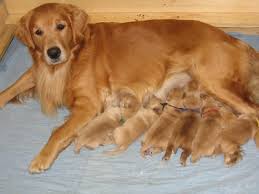
"The breeder told me he had all his shots."
grinninggoldens.com
There are few things clients say to me that aggravate me more. This one isn't the clients fault. Breeders who give out wrong information or are deliberately misleading about needed vaccines drive me nuts. Please don't get me wrong. There are many really good breeders, people who breed because they love a certain type of dog or cat and want to do it right- breeding for temperament, health and longevity.
But there are some people who don't know what they are doing. And they seem to delight in putting really bad information out there like it is gospel truth. For example- "the pup has had all needed shots" at 8 weeks of age. UGH
OK here are the facts. Puppies and kittens get antibodies (infection fighters) from their mother, if the mother was properly vaccinated. These antibodies provide immunity to the puppies. Newborns drink these antibodies in their mother's milk. The antibodies cross over the intestinal lining intact and get to work keeping the babies safe from common diseases. This is good.
This immunity from mom doesn't last forever. And thanks to some amazing scientists over the years, we have developed ways to re-create immunity. Our immune systems have memory. Once you have been exposed to and defeated a disease, the body keeps a blueprint of the successful disease-fighting agents on file. Then, if the same disease is found later, it can be fought off faster, sometimes before we realize we are sick. Vaccines take the place of the initial disease encounter. They are tailored to stimulate the immune system to fight off an invader that doesn't actually make us sick, but then the blueprint is still available to fight off the real thing, should it ever be encountered. Obviously, I'm trying to simplify a bit. I'm sure you can find more complete explanations, I just didn't want to copy an immunology text onto the blog. Maybe just one picture, for kicks and giggles:

wikipedia.com
Back to the puppies and kittens. Mom's immunity in their systems lasts a few weeks. But somewhere between six and fourteen weeks of age, that immunity goes away. The babies are now susceptible to diseases. Nasty, life-threatening things like parvovirus. This is where we step in.
Most puppies and kittens will start getting vaccines about 6-8 weeks of age. They really don't need them any earlier, except perhaps if they were never nursed. This is not a random age choice. This is the early end of the loss of mom's immunity. We will then booster the vaccine (re-vaccinate) every 3-4 weeks until the puppy or kitten is over 14-16 weeks old. There is science to this, I swear. The vaccine provides better immunity that mom's alone in this time frame, but the lingering effects of mom's immunity and the immature state of the immune system don't allow the blueprints to be stored long-term. So we have to remind the system what it needs to be prepared to fight.
One the puppy or kitten is over that 14-16 week mark, the immune system can be expected to store the blueprint longer, generally for about a year for most diseases. So we usually give the last set of vaccines at about 4-5 months of age. Then we can schedule spay or neuter (but that's a discussion for another day).
So there you have it. This is why I go slightly nuts when I am presented with a cute, fuzzy, 10 week old puppy and am told that he had all his shots.
Or picture this scene:
Pitiful puppy on the exam table, about 5 months old, thin, tired, dehydrated because she has spent the last few hours/days vomiting and having severe diarrhea. The parvovirus test is positive for the disease.

greenwichtime.com
Me: "Parvo is a virus that causes life-threatening vomiting and diarrhea. I can't treat the virus. All we can do now is support her system and hope that she can fight the virus off herself. She may die. And the treatment to try to save her life will be expensive."
Owner: "But the breeder said she had all her shots! They gave her her parvo shots!"
Me: "How long have you had her?"
Owner: "Since she was 8 weeks old."
See the reason for my anxiety? This is a preventable disease. Now the person in the above scene will need to find money to pay for treatment that might not work. The owner didn't know. She was making decisions based on the information she was given when she bought the puppy. If the breeder had done the responsible thing, recommended monthly visits to the vet to discuss care and get shots, this could have been completely avoided.
Enjoy your pets!
grinninggoldens.com
There are few things clients say to me that aggravate me more. This one isn't the clients fault. Breeders who give out wrong information or are deliberately misleading about needed vaccines drive me nuts. Please don't get me wrong. There are many really good breeders, people who breed because they love a certain type of dog or cat and want to do it right- breeding for temperament, health and longevity.
But there are some people who don't know what they are doing. And they seem to delight in putting really bad information out there like it is gospel truth. For example- "the pup has had all needed shots" at 8 weeks of age. UGH
OK here are the facts. Puppies and kittens get antibodies (infection fighters) from their mother, if the mother was properly vaccinated. These antibodies provide immunity to the puppies. Newborns drink these antibodies in their mother's milk. The antibodies cross over the intestinal lining intact and get to work keeping the babies safe from common diseases. This is good.
This immunity from mom doesn't last forever. And thanks to some amazing scientists over the years, we have developed ways to re-create immunity. Our immune systems have memory. Once you have been exposed to and defeated a disease, the body keeps a blueprint of the successful disease-fighting agents on file. Then, if the same disease is found later, it can be fought off faster, sometimes before we realize we are sick. Vaccines take the place of the initial disease encounter. They are tailored to stimulate the immune system to fight off an invader that doesn't actually make us sick, but then the blueprint is still available to fight off the real thing, should it ever be encountered. Obviously, I'm trying to simplify a bit. I'm sure you can find more complete explanations, I just didn't want to copy an immunology text onto the blog. Maybe just one picture, for kicks and giggles:

wikipedia.com
Back to the puppies and kittens. Mom's immunity in their systems lasts a few weeks. But somewhere between six and fourteen weeks of age, that immunity goes away. The babies are now susceptible to diseases. Nasty, life-threatening things like parvovirus. This is where we step in.
Most puppies and kittens will start getting vaccines about 6-8 weeks of age. They really don't need them any earlier, except perhaps if they were never nursed. This is not a random age choice. This is the early end of the loss of mom's immunity. We will then booster the vaccine (re-vaccinate) every 3-4 weeks until the puppy or kitten is over 14-16 weeks old. There is science to this, I swear. The vaccine provides better immunity that mom's alone in this time frame, but the lingering effects of mom's immunity and the immature state of the immune system don't allow the blueprints to be stored long-term. So we have to remind the system what it needs to be prepared to fight.
One the puppy or kitten is over that 14-16 week mark, the immune system can be expected to store the blueprint longer, generally for about a year for most diseases. So we usually give the last set of vaccines at about 4-5 months of age. Then we can schedule spay or neuter (but that's a discussion for another day).
So there you have it. This is why I go slightly nuts when I am presented with a cute, fuzzy, 10 week old puppy and am told that he had all his shots.
Or picture this scene:
Pitiful puppy on the exam table, about 5 months old, thin, tired, dehydrated because she has spent the last few hours/days vomiting and having severe diarrhea. The parvovirus test is positive for the disease.
greenwichtime.com
Me: "Parvo is a virus that causes life-threatening vomiting and diarrhea. I can't treat the virus. All we can do now is support her system and hope that she can fight the virus off herself. She may die. And the treatment to try to save her life will be expensive."
Owner: "But the breeder said she had all her shots! They gave her her parvo shots!"
Me: "How long have you had her?"
Owner: "Since she was 8 weeks old."
See the reason for my anxiety? This is a preventable disease. Now the person in the above scene will need to find money to pay for treatment that might not work. The owner didn't know. She was making decisions based on the information she was given when she bought the puppy. If the breeder had done the responsible thing, recommended monthly visits to the vet to discuss care and get shots, this could have been completely avoided.
Enjoy your pets!
Sunday, April 1, 2012
SHOOT!
Let's talk shots.
I like lemon drops. And my brother once got smashed on something called a Louisiana leg-spreader.
But that's not really what I want to discuss. Sorry. Instead, let's talk about the shots we vets give your pets. The vaccines.
Some people will have you believe that vaccines are not important for health. Some will tell you that vaccines are actually dangerous. Some will tell you that they are absolutely essential at every annual or semi-annual vet visit. So what is the truth?
The truth is fluid. We are constantly re-evaluating the risks and benefits of all vaccines. This is actually true on the human side of medicine as well as on my side. So there may be changes in the recommendations of which vaccines to give, when in life and how often to give them. Even the best methods to administer them. Vets "in the trenches" are left to shuffle through the evidence and the recommendations and develop protocols for our patients that we are comfortable with.
And herein lies one of the basic issues. I'm not exactly sure just how it works with people, but at the pediatrician level at least there appears to be one set code of rules for vaccines. These are set by a group and are followed by all pediatricians. Schools require that these codes are followed. There is consistency. Vets get recommendations from groups such as the American Animal Hospital Association or the Association of Feline Practitioners, but we don't have a group that we allow to set the rules that we all follow. Veterinarians are pretty independent by nature, and we don't like to be dictated to.
So this leaves us in something of a quandary. Where do we get our information? Who do we trust? Do we trust the companies that make the vaccines to have the best, unbiased information? We need to know the agenda of whomever we are trusting for the data that we use to set our vaccine schedules. We hope that our associations will look at all the evidence available and help develop recommendations that are based on good science. Are they?
This is why the protocols we all follow may change from time to time. We are all, as a group and as individual veterinarians within our own practices, continually re-examining the evidence we have at hand. We are sometimes slow to change, but that is because we need to be convinced that the change is safe and effective. So this month I want to talk shots. I will not claim to have all the answers. I may well ruffle some feathers. I hope to make you think just a little about some of the blanket statements you hear.
Then maybe we can go out for a lemon drop or two.
I like lemon drops. And my brother once got smashed on something called a Louisiana leg-spreader.
But that's not really what I want to discuss. Sorry. Instead, let's talk about the shots we vets give your pets. The vaccines.
Some people will have you believe that vaccines are not important for health. Some will tell you that vaccines are actually dangerous. Some will tell you that they are absolutely essential at every annual or semi-annual vet visit. So what is the truth?
The truth is fluid. We are constantly re-evaluating the risks and benefits of all vaccines. This is actually true on the human side of medicine as well as on my side. So there may be changes in the recommendations of which vaccines to give, when in life and how often to give them. Even the best methods to administer them. Vets "in the trenches" are left to shuffle through the evidence and the recommendations and develop protocols for our patients that we are comfortable with.
And herein lies one of the basic issues. I'm not exactly sure just how it works with people, but at the pediatrician level at least there appears to be one set code of rules for vaccines. These are set by a group and are followed by all pediatricians. Schools require that these codes are followed. There is consistency. Vets get recommendations from groups such as the American Animal Hospital Association or the Association of Feline Practitioners, but we don't have a group that we allow to set the rules that we all follow. Veterinarians are pretty independent by nature, and we don't like to be dictated to.
So this leaves us in something of a quandary. Where do we get our information? Who do we trust? Do we trust the companies that make the vaccines to have the best, unbiased information? We need to know the agenda of whomever we are trusting for the data that we use to set our vaccine schedules. We hope that our associations will look at all the evidence available and help develop recommendations that are based on good science. Are they?
This is why the protocols we all follow may change from time to time. We are all, as a group and as individual veterinarians within our own practices, continually re-examining the evidence we have at hand. We are sometimes slow to change, but that is because we need to be convinced that the change is safe and effective. So this month I want to talk shots. I will not claim to have all the answers. I may well ruffle some feathers. I hope to make you think just a little about some of the blanket statements you hear.
Then maybe we can go out for a lemon drop or two.
Monday, February 27, 2012
addendum


Helpful treat dispensers! One way to help increase exercise for both cats and dogs is to get toys that make them move. There's an amazing variety of toys out there that will stimutate pets' brains, and keep their interest by occasionally popping out a treat. How cool is that? You can even consider putting the whole day's calorie content in a treat ball and letting your pet "hunt" for food all day long. Awesome!
Thursday, February 9, 2012
Fat or Fluffy? obesity part I
Hi, my name is Kate, and I am obese. I am not alone. The stats they throw at us all day long say that 66% or more Americans are overweight or obese. This has rightly been labeled a health epidemic. There are many reasons for this problem of epidemic proportions, but it boils down to one or two simple issues. We like to eat. We like to eat too much. We like to eat too much of the wrong thing. Personally, I like sugar. In just about every form. Except mint- mint is yucky. Chocolate mint ice cream is just a waste of good chocolate.
We 66%ers take too many calories in. And we don't get enough good exercise to use them up. When the ins are higher than the outs, we get calories stored in the form of fat. Muffin tops. Love handles. Saddlebags. Bingo arms. You get the idea. Historically, bodies developed to store calories during the good times that would then be available for energy during the inevitable bad times. But in developed countries the bad times are pretty much non-existent.
So what does this have to do with pets, you ask. Everything. Our pets in the US share some of our health issues, and obesity is a big one. The same stats apply. As many as 66% of our cats and dogs are overweight and obese. So how can this be? My Bella doesn't get a sudden sugar craving at midnight, get into the freezer, pull out a pint of Ben and Jerry's and chow down. Nope. I feed her. So, again, how does she get fat? Where do we place the blame. Again, the basic issue is simple, but the context is a bit more complex.
Here's the thing. I am obese. My BMI is 31 (BMI is a height-to-weight calculation for people, you can find charts online). But my friends and family tell me I'm not obese. Not fat. They will occasionally agree that I am a bit overweight. Then they offer me dessert.
We are so used to seeing ourselves and others in a overweight state that we have lost perspective. We no longer know what is normal and healthy in our body types. This is true for our pets as well. Many pet owners are so used to seeing their overweight pet they have no idea that it is not, in fact, normal. I frequently hear from pet owners with dogs of normal weight that they are badgered by friends, family and strangers about their dogs being underweight.
It's our fault. This is an important concept to get: our pet's obesity is OUR fault. We feed them. We overfeed and underexercise them. We have that control. So let's take that control back. In the end, we will have happier, healthier pets, who will likely be part of out lives longer.
Enough lecture for the moment. I will post part 2 soon. If you are interested in more information- like how to tell if your pet is overweight, exercise and diet strategies, and the long-term effects of obesity, talk to your vet. I will have an on-line lecture about weight issues linked through the website www.angelspaws.com. Feel free to listen to that one, and the other informational sessions Tammy Wynn and I are recording.!
Enjoy your pets!
 photobucket.com
We 66%ers take too many calories in. And we don't get enough good exercise to use them up. When the ins are higher than the outs, we get calories stored in the form of fat. Muffin tops. Love handles. Saddlebags. Bingo arms. You get the idea. Historically, bodies developed to store calories during the good times that would then be available for energy during the inevitable bad times. But in developed countries the bad times are pretty much non-existent.
So what does this have to do with pets, you ask. Everything. Our pets in the US share some of our health issues, and obesity is a big one. The same stats apply. As many as 66% of our cats and dogs are overweight and obese. So how can this be? My Bella doesn't get a sudden sugar craving at midnight, get into the freezer, pull out a pint of Ben and Jerry's and chow down. Nope. I feed her. So, again, how does she get fat? Where do we place the blame. Again, the basic issue is simple, but the context is a bit more complex.
Here's the thing. I am obese. My BMI is 31 (BMI is a height-to-weight calculation for people, you can find charts online). But my friends and family tell me I'm not obese. Not fat. They will occasionally agree that I am a bit overweight. Then they offer me dessert.
We are so used to seeing ourselves and others in a overweight state that we have lost perspective. We no longer know what is normal and healthy in our body types. This is true for our pets as well. Many pet owners are so used to seeing their overweight pet they have no idea that it is not, in fact, normal. I frequently hear from pet owners with dogs of normal weight that they are badgered by friends, family and strangers about their dogs being underweight.
It's our fault. This is an important concept to get: our pet's obesity is OUR fault. We feed them. We overfeed and underexercise them. We have that control. So let's take that control back. In the end, we will have happier, healthier pets, who will likely be part of out lives longer.
Enough lecture for the moment. I will post part 2 soon. If you are interested in more information- like how to tell if your pet is overweight, exercise and diet strategies, and the long-term effects of obesity, talk to your vet. I will have an on-line lecture about weight issues linked through the website www.angelspaws.com. Feel free to listen to that one, and the other informational sessions Tammy Wynn and I are recording.!
Enjoy your pets!
photobucket.comTuesday, January 31, 2012
5 reasons to own a black dog
I love my dogs. Let's face it, I'm a veterinarian, I like pets. I like them big, I like them small, I like them short, I like them tall. (Can you tell I'm also mom to two youngsters?)
Currently, I live with two dogs. Spiker is a collie/aussie mix, and is a beautiful long-coated blue merle, with white feet and nose. He is truly stunning to look at. Bella is our 9 year old black lab. Bella came to us as a stray when she was very young. She's going grey now in the face, but she's still beautiful. And practical. Here are the five reasons to have a black dog in your house. (Disclaimer- pictures were all found on the web, I take no credit for them.)
5. Black fur doesn't show on black pants. Now, you could argue that black fur does show on white and khaki pants, and you would not be wrong. But, frankly, all fur shows on white and khaki. Trust me. I have had every color of fur on my pants at one time or another. But I wear black when I want to dress up, and having a light dog rub against me before I walk out the door leaves a trail on the pants. The black dog's fur just blends right in.

4. You can see black fur dustbunnies on the floor. I know, this doesn't sound like a good thing. But I am an indifferent housekeeper, and seeing the problem areas helps me spot-clean before people come to visit. The lighter fur will escape my attention until a 3 foot fur tumblweed blows across the floor in front of guests.

3. It's kind of fun when a black dog stands outside the kitchen door at night and all you see are her eyes reflecting the light from inside. Camoflage.

2. No one will every think it's a good idea to dye her an odd color. Pink and purple poodles may be fun to look at, but I like my Bella undyed.

1. The dirt doesn't show. Spiker is currently a muddy, muddy mess. Bella is equally muddy (I think), but it just doesn't show up on her. I don't look at her and think it's shower time. Spiker, on the other hand, is threatened with a shower on a daily basis. Which is not to say he gets one.

So there you go. Enjoy your pets. Even if they show dirt. Or are pink.
Currently, I live with two dogs. Spiker is a collie/aussie mix, and is a beautiful long-coated blue merle, with white feet and nose. He is truly stunning to look at. Bella is our 9 year old black lab. Bella came to us as a stray when she was very young. She's going grey now in the face, but she's still beautiful. And practical. Here are the five reasons to have a black dog in your house. (Disclaimer- pictures were all found on the web, I take no credit for them.)
5. Black fur doesn't show on black pants. Now, you could argue that black fur does show on white and khaki pants, and you would not be wrong. But, frankly, all fur shows on white and khaki. Trust me. I have had every color of fur on my pants at one time or another. But I wear black when I want to dress up, and having a light dog rub against me before I walk out the door leaves a trail on the pants. The black dog's fur just blends right in.
4. You can see black fur dustbunnies on the floor. I know, this doesn't sound like a good thing. But I am an indifferent housekeeper, and seeing the problem areas helps me spot-clean before people come to visit. The lighter fur will escape my attention until a 3 foot fur tumblweed blows across the floor in front of guests.
3. It's kind of fun when a black dog stands outside the kitchen door at night and all you see are her eyes reflecting the light from inside. Camoflage.
2. No one will every think it's a good idea to dye her an odd color. Pink and purple poodles may be fun to look at, but I like my Bella undyed.

1. The dirt doesn't show. Spiker is currently a muddy, muddy mess. Bella is equally muddy (I think), but it just doesn't show up on her. I don't look at her and think it's shower time. Spiker, on the other hand, is threatened with a shower on a daily basis. Which is not to say he gets one.
So there you go. Enjoy your pets. Even if they show dirt. Or are pink.
Subscribe to:
Posts (Atom)