The ongoing parsing of Reader's Digests article "50 Secrets Your Vet Won't Tell You" continues....
"New staff or training students sometimes practice injections or catheter placement on your pet. If you'd rather not allow your pet to be used this way, make sure you say something beforehand."
I am having trouble even starting to address this one.
Here's the fact- each state has a set of laws that lays out rules for who can do what. This is as true in veterinary medicine as it is on the human side. So I'm not sure to what this person is referring. Yes, there may be newly graduated vet techs in the practice. Just like the vet might be "new."
But you have to remember that these are highly trained professionals, not random people off the street. They have already completed training, and by law are allowed to perform tasks within their job descriptions. Is there some on the job training? Sure. there's a first (and second) time for everything. Even for me.
Seems to me that if you trust your vet to have hired competent staff, and to oversee them properly, this should not be a concern.
Enjoy your pets!
Monday, July 16, 2012

Saturday, July 14, 2012
secret #16- freebies
I am taking on Reader's Digest's article "50 Secrets Your Vet Won't Tell You." We continue.....
"Sometimes we do things for free just because we want to help the pet."
Yeah, well....I've been known to adjust some charges. And I know some things are done in the name of experience and practice for free or greatly reduced prices.
But don't expect to guilt us into it. That frequently backfires. We do have businesses to run, employess to pay, lights to keep on. IF we choose to offer our time and experience and recources for free, we will. Be greatful.
And yes, we do love animals. Really. And yes, we want to help. Really. In a perfect world we would never charge anyone for anything- we would practice veterinary medicine because we love to. In the world we are given, we need money to come in....because it does go out.
"Sometimes we do things for free just because we want to help the pet."
Yeah, well....I've been known to adjust some charges. And I know some things are done in the name of experience and practice for free or greatly reduced prices.
But don't expect to guilt us into it. That frequently backfires. We do have businesses to run, employess to pay, lights to keep on. IF we choose to offer our time and experience and recources for free, we will. Be greatful.
And yes, we do love animals. Really. And yes, we want to help. Really. In a perfect world we would never charge anyone for anything- we would practice veterinary medicine because we love to. In the world we are given, we need money to come in....because it does go out.
Friday, July 13, 2012
secret #15- one-eyed, three-legged dog named Lucky
"When people surrender their pets because they can't afford their problems, I often end up with them. I've got a 3-legged cat, a one-eyed cat, three dogs that required major surgeries, one goat and 11 chickens."
There are in-house jokes about vets and staff having the worst pets- they get obscure diseases, or "normal" diseases in large numbers. Or we take on someone else's problem pet.
But I caution you- don't assume that your vet will re-home a pet that is sick or has become inconvenient. We have to draw the line, and that line might involve a difficult decision on your part. We love to help, but we do not have infinite resources, either.
Enjoy your pets!
There are in-house jokes about vets and staff having the worst pets- they get obscure diseases, or "normal" diseases in large numbers. Or we take on someone else's problem pet.
But I caution you- don't assume that your vet will re-home a pet that is sick or has become inconvenient. We have to draw the line, and that line might involve a difficult decision on your part. We love to help, but we do not have infinite resources, either.
Enjoy your pets!
Monday, July 9, 2012
secret #14- people skills
"Every time we help a pet, we help a person. The classic example is the 80-year old grandma who has nothing in life but her cat. She's a widow with very limited social contact, and the cat is what connects her to life. So when we help her cat, she's really the one we're helping."
True.
Vet school teaches us how to treat animals. Life and experience teach us how to treat people. A vet can be excellent medically but never "get" the people side of things. The best vets I have known have been smart, great with medicine and surgery, but also really compassionate with the pet's people. These are the docs I admire the most.
Enjoy your pets!
True.
Vet school teaches us how to treat animals. Life and experience teach us how to treat people. A vet can be excellent medically but never "get" the people side of things. The best vets I have known have been smart, great with medicine and surgery, but also really compassionate with the pet's people. These are the docs I admire the most.
Enjoy your pets!
Thursday, July 5, 2012
secret #13- scraps
"You should never give pets chocolate, because it is toxic to most of them. But my cat is obsessed with it, and is all over me when I'm eating it, so sometimes I give her a sliver. Just and itsy-bitsy, tiny one."
Another example of us not necessarily following our own rules. Yes, we are human. We have pets that get table food sometimes. Some of us even *gasp* have overweight pets. (Insert grin here)
Chocolate can be quite toxic to dogs. They do not process the caffeine and another component- theobromine- the way we do, and it can cause vomiting and diarrhea, increased heart rate, anxiety , and even death. The darker the chocolate, the more dangerous it is. Chocolate covered coffee beans- well, let's not go there.
I am not certain how toxic chocolate is for cats. I've never had reason to check before. There are other things to avoid in cats- over the counter pain medications, especially acetaminophen (Tylenol), garlic and onions, can be deadly. So proceed with caution. A bite of this or that, the last of the milk and cereal in your bowl, is not likely to do harm.
And as for dogs- keep the chocolate put up. And the coffee. And the grapes, raisins, raw meat, bones. Sugarless gum with xylitol can cause severe low blood sugar. Potential toxicities abound, so dog-proof the larder.
Enjoy your pets!
Another example of us not necessarily following our own rules. Yes, we are human. We have pets that get table food sometimes. Some of us even *gasp* have overweight pets. (Insert grin here)
Chocolate can be quite toxic to dogs. They do not process the caffeine and another component- theobromine- the way we do, and it can cause vomiting and diarrhea, increased heart rate, anxiety , and even death. The darker the chocolate, the more dangerous it is. Chocolate covered coffee beans- well, let's not go there.
I am not certain how toxic chocolate is for cats. I've never had reason to check before. There are other things to avoid in cats- over the counter pain medications, especially acetaminophen (Tylenol), garlic and onions, can be deadly. So proceed with caution. A bite of this or that, the last of the milk and cereal in your bowl, is not likely to do harm.
And as for dogs- keep the chocolate put up. And the coffee. And the grapes, raisins, raw meat, bones. Sugarless gum with xylitol can cause severe low blood sugar. Potential toxicities abound, so dog-proof the larder.
Enjoy your pets!
Tuesday, July 3, 2012
Secret #12- show me your liscense and registration, please
"At a veterinary meeting I attended, it came out that more than half the vets there had not licensed their dogs, which is required by local law."
Well, this may be a case of "do as I say, not as I do." Or perhaps "shoemakers wives go barefoot and doctor's wives die young."
My dogs are licensed. It is the right thing to do, and the legal one. I encourage my puppy owners to get their licenses. Vets should do the same. I hate to think that the lack of licesnsure is deliberate- we are all busy, and it's easy to overlook some things.
So, vets, let's be sure we "practice what we preach" and take all the right steps to keep our pets safe.
Enjoy your pets!
Well, this may be a case of "do as I say, not as I do." Or perhaps "shoemakers wives go barefoot and doctor's wives die young."
My dogs are licensed. It is the right thing to do, and the legal one. I encourage my puppy owners to get their licenses. Vets should do the same. I hate to think that the lack of licesnsure is deliberate- we are all busy, and it's easy to overlook some things.
So, vets, let's be sure we "practice what we preach" and take all the right steps to keep our pets safe.
Enjoy your pets!
Monday, July 2, 2012
Secret #11- OUCH!
"Alot of veterinarians have told me matter-of-factly that they still don't use painkillers for procedures that we know are painful. They think that dogs and cats don't need it or that feeling pain after surgery is good because it keeps them from moving around too much. But reasearch has shown that pets who are in less pain heal faster, sleep better, and don't move around as much."
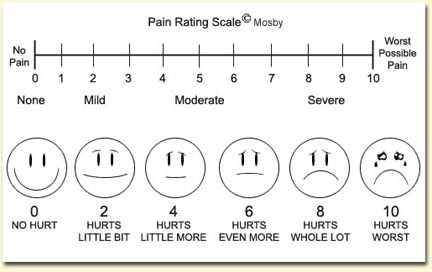
In my opinion, painkillers are not an option. Pre-empting pain by giving pain medication before surgery helps recovery immensely. Pain meds after extensive (and maybe not so extensive) surgery is a given.
It's true pets react differently to pain that we do, but that doesn't mean they don't feel it the same way we do. And there are, in fact, very good studies showing how much better pets do when their pain is well controlled. So, yes, I agree.
There may be vets who do not understand the benefits of excellent pain control, but I hesitate to agree that there are "alot" of them. I think the evidence for pain control is out there, agreed upon, and generally considered to be the standard of care. Sure, there are sub-par vets in existance, but I think they are a distinct minority.
Enjoy your pets!
In my opinion, painkillers are not an option. Pre-empting pain by giving pain medication before surgery helps recovery immensely. Pain meds after extensive (and maybe not so extensive) surgery is a given.
It's true pets react differently to pain that we do, but that doesn't mean they don't feel it the same way we do. And there are, in fact, very good studies showing how much better pets do when their pain is well controlled. So, yes, I agree.
There may be vets who do not understand the benefits of excellent pain control, but I hesitate to agree that there are "alot" of them. I think the evidence for pain control is out there, agreed upon, and generally considered to be the standard of care. Sure, there are sub-par vets in existance, but I think they are a distinct minority.
Enjoy your pets!
Subscribe to:
Posts (Atom)